Path-Lock Expert
Architecture-level separation of think and no-think modes through deterministic control-token routing.
The Problem
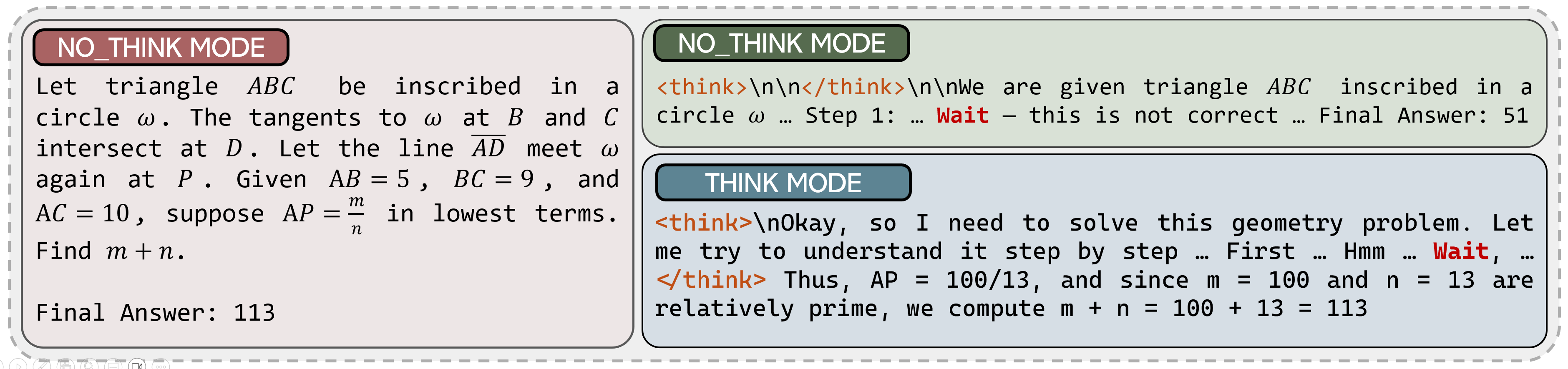
Hybrid-thinking language models promise two useful behaviors in one model: a deliberate think mode for difficult problems and a fast no-think mode for direct answers. In practice, however, the boundary is porous. Even when no-think is requested, a model may generate long answers and reflective phrases such as “wait” or “hmm.” We call this failure reasoning leakage. It increases latency and token use, and makes the supposedly direct mode unpredictable.
Architecture-Level Mode Separation
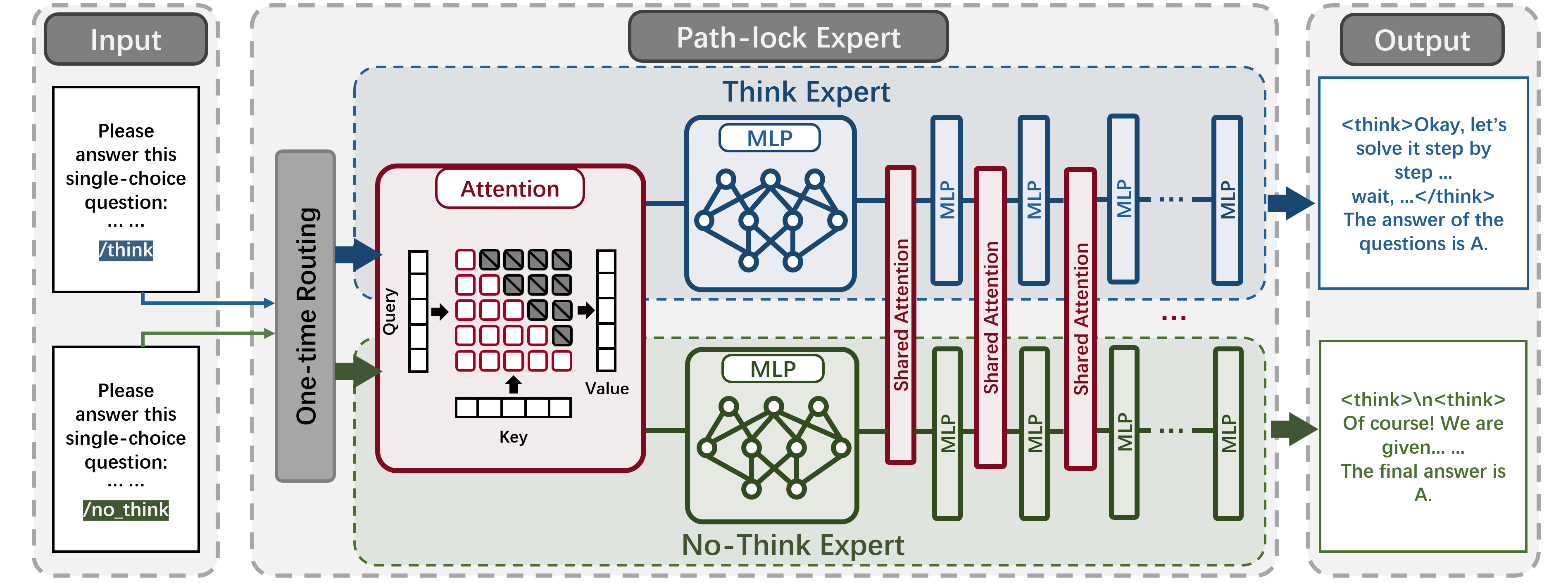
Path-Lock Expert: Separating Reasoning Mode in Hybrid Thinking via Architecture-Level Separation asks whether this is not only a training problem, but also an architectural interference problem. A dense decoder asks the same feed-forward parameters to support two competing generation behaviors. Path-Lock Expert (PLE) therefore replaces the MLP in each decoder layer with two semantically locked experts: one for think and one for no-think.
A deterministic router reads the control token once and locks the entire sequence to one expert path across every layer and decoding step. Attention, embeddings, normalization, and the language-model head stay shared. Only one expert is active at inference time, avoiding a learned router, load-balancing losses, or a more complicated reinforcement-learning pipeline.
Results and Takeaway
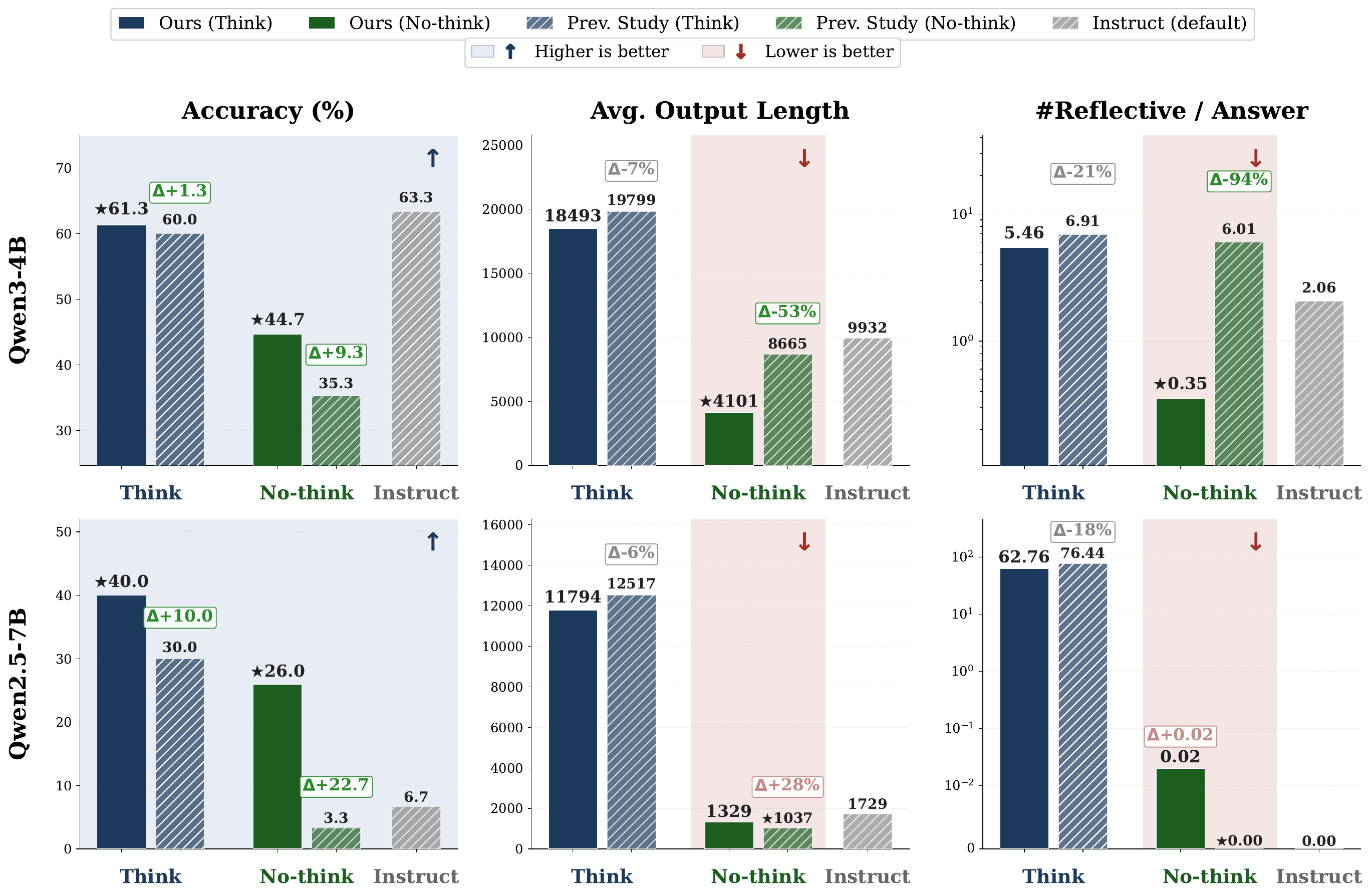
Across mathematical and scientific reasoning benchmarks, PLE produces a more useful no-think mode while preserving strong think-mode performance. On Qwen3-4B and AIME24, it generates 17× fewer reflective tokens, cuts average no-think output length from 8,665 to 4,101 tokens, and improves no-think accuracy from 35.33% to 44.67%, while maintaining think accuracy (61.33% vs. 60.00%).
The central conclusion is that controllable hybrid thinking is partly an architectural problem. Training recipes can reduce leakage, but separating mode-specific feed-forward pathways provides a direct, complementary way to make the selected mode reliable by design. The paper was accepted to COLM 2026.