Demystifying Hybrid Thinking
An empirical study of whether hybrid-thinking language models truly separate think and no-think behavior.
Can a Model Really Stop Thinking?
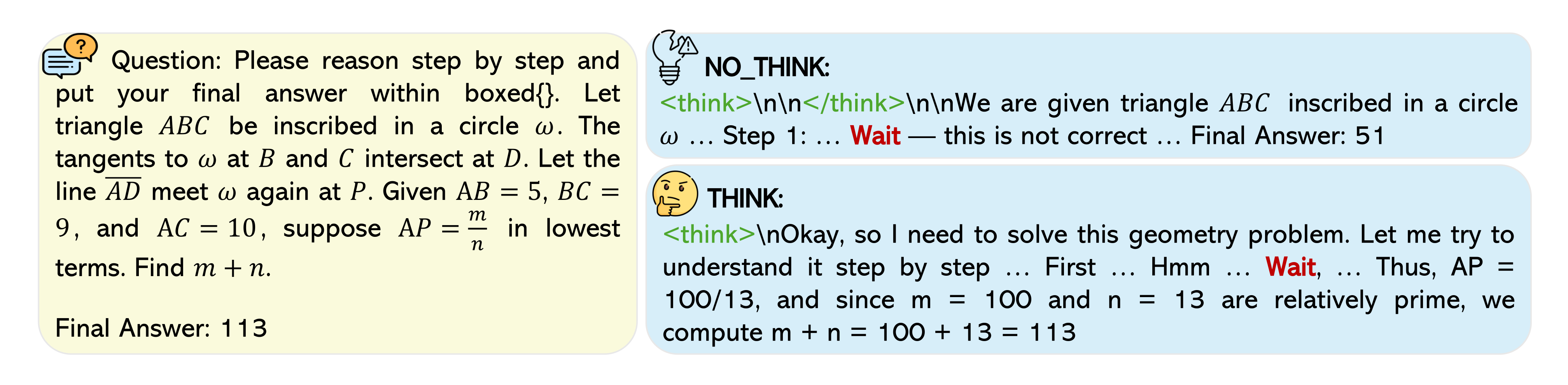
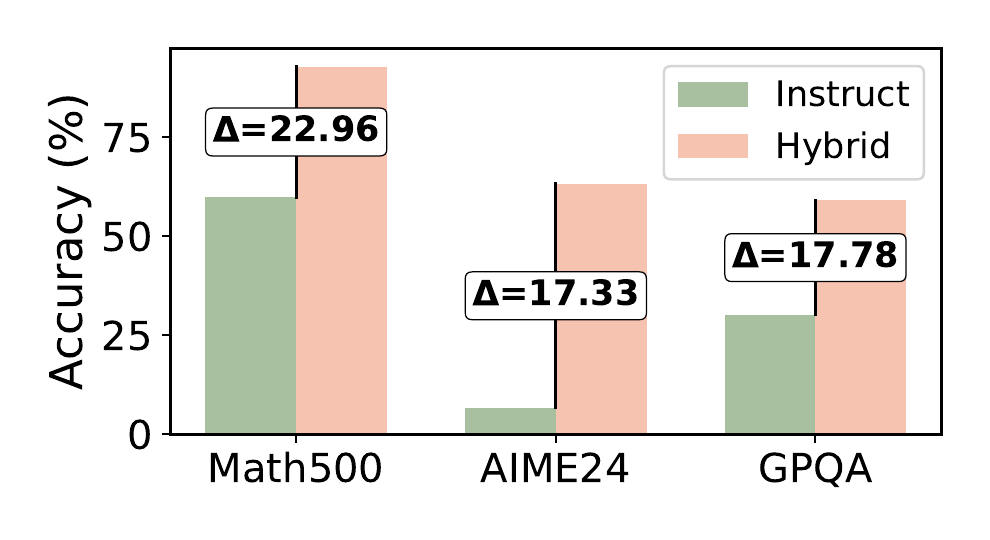
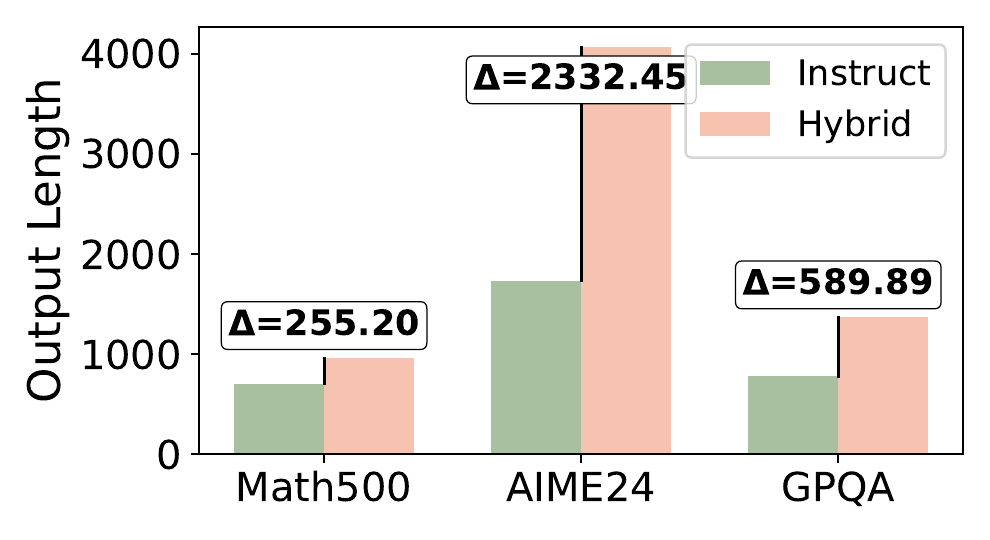
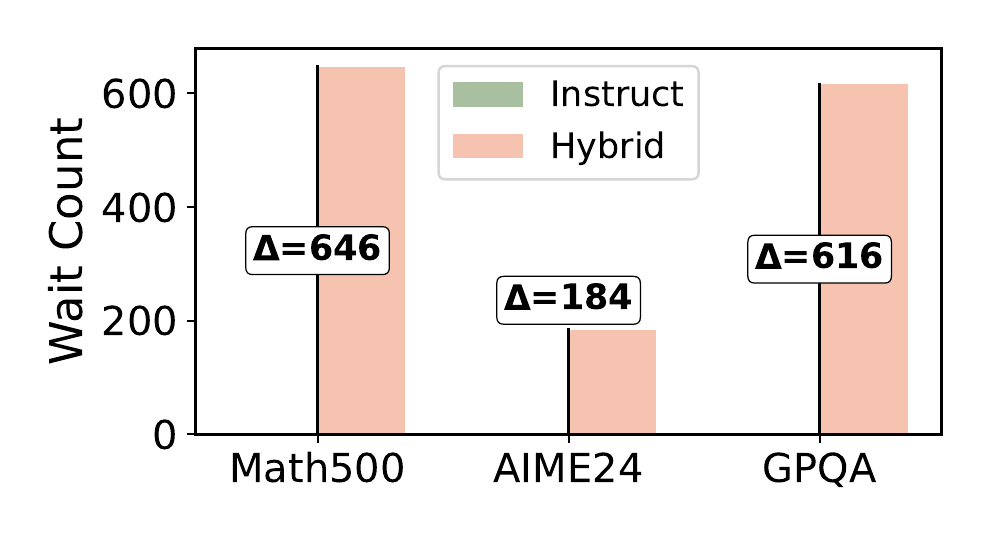
Hybrid-thinking models expose think and no-think controls so users can trade reasoning depth for speed. Demystifying Hybrid Thinking: Can LLMs Truly Switch Between Think and No-Think? begins by testing whether those controls create genuinely distinct behaviors. The answer is only partially: no-think responses are shorter than think responses, but they often remain much longer and more reflective than those of a direct-answer instruction model.
What Controls the Switch?
We systematically vary the data and training design to identify four factors that most strongly affect mode separation:
- Data scale: sufficiently large hybrid-thinking datasets are needed for stable control.
- Unpaired supervision: using think and no-think answers from different questions yields cleaner separation than pairing both answers with the same question.
- Mode balance: moderately increasing the share of no-think data shortens direct responses without sacrificing accuracy.
- Training order: a two-phase schedule—first learning strong reasoning, then learning hybrid control—outperforms mixing both objectives from the beginning.
A Practical Recipe
Combining these findings gives a simple recipe for more controllable hybrid thinking: use larger, unpaired data; keep a moderate no-think proportion; and apply hybrid training only after establishing the model’s reasoning ability. On MATH500, this reduces average no-think output length from 1,085 to 585 tokens and reasoning-supportive token occurrences from 5,917 to 522, while maintaining accuracy in both modes.
The work turns a vague behavior—“the model does not really stop thinking”—into a measurable training problem and a set of actionable design choices. It also motivates the later Path-Lock Expert project, which tackles the remaining interference at the architecture level. The paper was accepted to the EMNLP 2026 Main Conference.